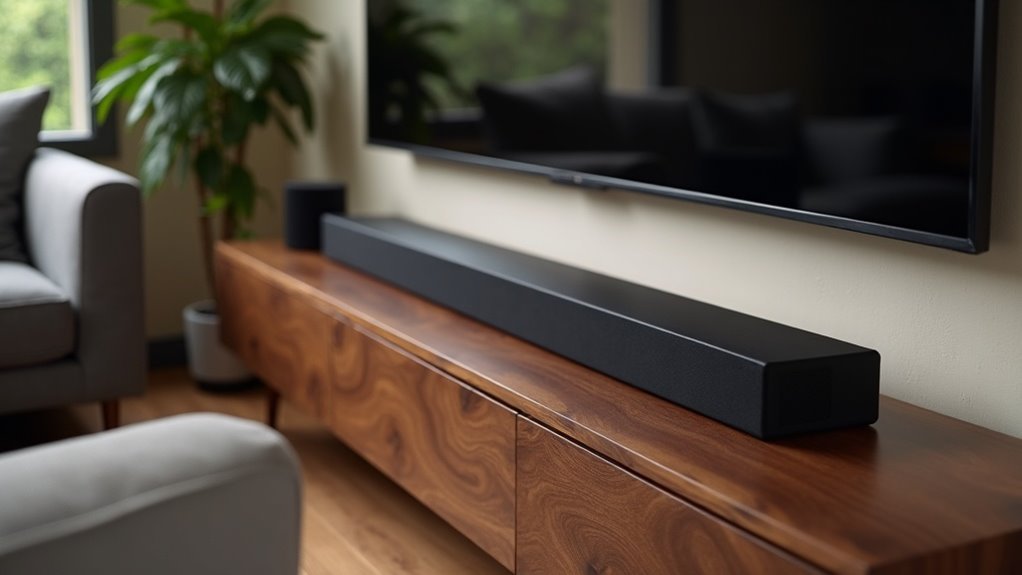
A passive soundbar is an audio device that does not include built-in amplification. Instead, it relies on an external amplifier to deliver sound. This configuration offers superior audio quality and customization options, allowing you to tailor your audio experience to your preferences and room acoustics. While it may require a greater investment and installation effort, the enhanced sound quality often makes it worthwhile. If you’re interested in learning more about how passive soundbars compare to active soundbars, there is plenty more information available on the topic.
Key Takeaways
- A passive soundbar requires an external amplifier or AV receiver for sound production, as it lacks built-in amplification.
- It consists of multiple speaker drivers, delivering superior audio quality compared to active soundbars.
- Passive soundbars allow for customizable audio setups, integrating seamlessly with in-ceiling and in-wall speakers.
- Installation can be complex, often requiring professional help for optimal performance and sound quality.
- While initial costs may be higher, passive soundbars offer long-term value through enhanced audio experiences and upgrade potential.
Understanding Passive Soundbars
While you might be familiar with active soundbars that come with built-in amplifiers, passive soundbars offer a different approach to home audio.
Lacking built-in amplification, a passive soundbar requires an external amplifier or AV receiver for operation. Typically composed of multiple speaker drivers, these soundbars can deliver superior audio quality, especially when paired with a compatible amplifier.
They excel in complex home theater setups, allowing you to customize your audio by selecting different components. Furthermore, passive soundbars provide greater flexibility for future upgrades, making them an appealing choice for audio enthusiasts who prioritize quality and adaptability in their soundbar setups.
Advantages of Passive Soundbars
When you think about enhancing your home audio experience, the benefits of passive soundbars become clear.
These soundbars provide superior audio quality by utilizing an external amplifier, which enhances sound fidelity and clarity beyond what active options can achieve. The ability to choose and upgrade amplifiers allows for a tailored setup that can be customized to suit your specific preferences and room acoustics.
Furthermore, you can seamlessly integrate in-ceiling and in-wall speakers, creating a versatile home theater environment. With the option for individual speaker adjustments, passive soundbars are ideal for audiophiles seeking an immersive listening experience, making them a compelling choice for those who prioritize outstanding sound quality.
Disadvantages of Passive Soundbars
Despite the appeal of enhanced audio quality, passive soundbars come with several disadvantages that can deter potential buyers.
They require a separate amplifier, which raises your overall setup cost compared to active soundbars. Installation complexity can be intimidating, often demanding technical knowledge and careful planning.
For casual listeners, this reliance on external equipment can be a significant drawback, as it limits the convenience of a straightforward plug-and-play audio solution.
Additionally, the need for compatible amplifiers and extra speakers can escalate expenses, making passive soundbars less accessible for everyday consumers who seek simplicity without compromising on sound quality.
How Passive Soundbars Work
Understanding how passive soundbars work is essential for maximizing your audio experience.
These soundbars rely on external amplification, using speaker cables to connect to an amplifier or AV receiver, which powers multiple speaker drivers for a rich sound output.
With this setup, you gain the flexibility to tailor your audio system, enhancing both quality and performance as you upgrade components.
Whether you’re looking to improve your movie nights or elevate your music listening, passive soundbars can provide a customizable audio solution that meets your needs.
Amplification Process Explained
Passive soundbars operate through a distinct amplification process that sets them apart from their active counterparts. To power the speaker drivers, an external amplifier is required, as passive soundbars lack built-in amplification. The process begins when an audio signal from your source device reaches the external amplifier, which boosts the signal to a suitable level. This amplified signal is then transmitted to the passive soundbar, where multiple speaker drivers work to convert the electrical energy into sound waves. With multiple channels, passive soundbars significantly enhance your audio experience, offering superior sound quality when paired with high-quality amplification.
| Step | Description |
|---|---|
| 1. Signal Source | Audio signal sent from source device |
| 2. Amplification | External amplifier boosts the signal |
| 3. Transmission | Amplified signal sent to passive soundbar |
| 4. Sound Production | Speaker drivers convert signal into sound waves |
Speaker Configuration Overview
The design of a passive soundbar revolves around its unique speaker configuration, which plays an essential role in delivering high-quality audio.
These soundbars typically incorporate front left, center, and right speakers to create immersive audio output. Since they lack built-in amplification, you’ll need an external amplifier or AV receiver to power the speakers and manage audio processing.
Depending on the model, a passive soundbar can support various channels, offering everything from basic stereo to more complex surround sound setups. This flexibility allows for customizable installations, enhancing your overall audio experience and making it easier to connect additional speakers, making them a versatile choice for any soundbar enthusiast.
Visual Characteristics of Passive Soundbars
When you look at a passive soundbar, you’ll notice its distinct visual characteristics that set it apart from active models.
These soundbars emphasize a straightforward design, often resembling traditional speaker setups. Key features include:
- Speaker terminals on the back for connecting to an external amplifier, lacking any power cord.
- Multiple speaker drivers, including dedicated front left, center, and right speakers, enhancing your audio experience.
- A design without digital displays or remote controls, indicating no built-in amplification.
These visual traits highlight the necessity of external components to function effectively, making passive soundbars an interesting choice for audiophiles.
Comparing Passive and Active Soundbars
When you’re weighing the differences between passive and active soundbars, setup complexity and sound quality are key factors to contemplate.
Active soundbars provide a straightforward plug-and-play experience, making them ideal for those who prefer simplicity.
In contrast, passive soundbars require more intricate installation and external amplification, which can be a bit more challenging.
However, if you’re seeking superior sound fidelity and the ability to customize your audio setup, the effort invested in configuring a passive soundbar can yield significant rewards in sound quality.
Setup Complexity
While many users appreciate the simplicity of active soundbars, passive soundbars introduce a layer of complexity that can be intimidating for those unfamiliar with audio systems.
To set up a passive soundbar, you’ll need an external amplifier or AV receiver, which adds to the setup complexity. Here are some important considerations:
- Careful planning is essential for wiring and connections to ensure optimal placement and functionality.
- Knowledge of audio equipment compatibility is vital to avoid suboptimal performance and to maximize your audio experience.
- Additional costs arise from needing both the soundbar and the amplifier, which can be a significant investment.
While passive soundbars may not be as user-friendly as their active counterparts, they offer a rewarding audio experience for those willing to invest the time and effort into mastering their setup.
Sound Quality Comparison
While many users prioritize convenience in their audio setups, the sound quality of passive soundbars often stands out compared to their active counterparts, making them a preferred option for serious audiophiles.
Passive soundbars utilize external amplifiers, resulting in higher fidelity audio and clearer output. With multiple speaker drivers, they deliver a richer, more immersive experience, particularly in surround sound configurations. This separation of amplification helps to reduce distortion and interference.
On the other hand, active soundbars come with integrated components for user-friendliness but may limit audio customization, potentially compromising the sound quality that discerning listeners seek.
Ultimately, your choice should reflect your audio preferences and the level of commitment you’re ready to make to your sound setup.
Choosing the Right Soundbar for Your Needs
How do you choose the right soundbar to elevate your audio experience? Start by evaluating your existing audio setup since passive soundbars require an external amplifier to function.
Evaluate your audio setup carefully, especially if considering a passive soundbar that needs an external amplifier.
Here are some key factors to consider:
- Sound Quality: More speaker drivers generally enhance audio immersion, providing a richer sound experience.
- Customization: Passive soundbars offer flexibility in selecting and upgrading amplifiers, allowing you to tailor your audio setup to your liking.
- Installation: Be prepared for potential professional installation or a bit of technical knowledge to achieve the ideal setup for your soundbar.
Balancing your budget with the need for quality and customization will help you find a soundbar that meets your specific needs, ensuring an enriched listening experience that’s uniquely yours.