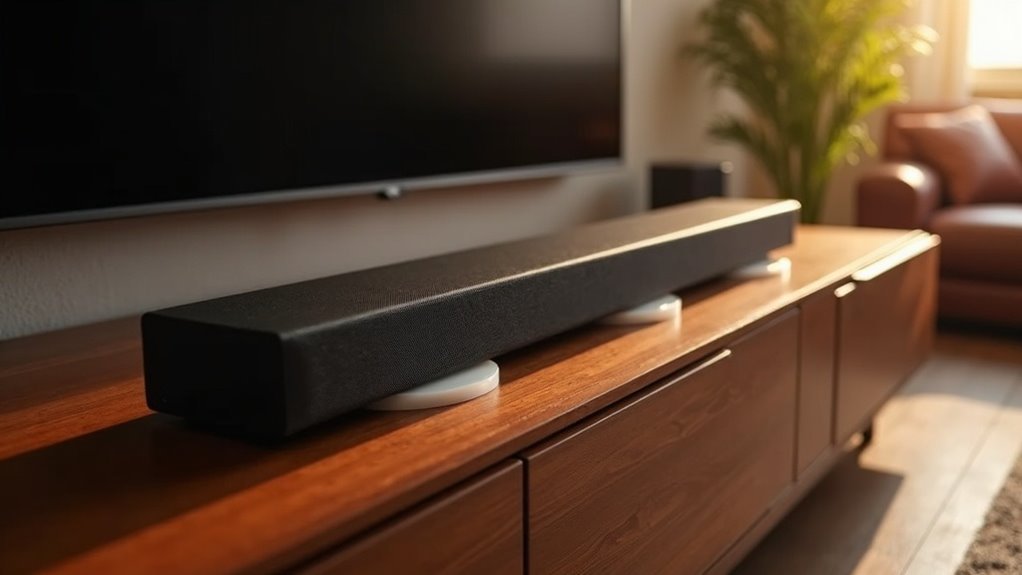
To isolate your soundbar from cabinet resonance, use high-density acoustic foam or Sorbothane pads to absorb vibrations. Place the pads underneath the soundbar to decouple it from the cabinet, which helps reduce distortion in the 200-300 Hz range. Ensure that the soundbar is positioned at ear level and maintain a distance from walls to optimize sound clarity. It’s important to regularly check for stability and alignment to avoid misalignment issues. Additionally, there are more effective techniques and materials available that can further enhance your soundbar setup.
Key Takeaways
- Use high-density acoustic foam isolation pads to absorb vibrations and enhance sound clarity, minimizing resonance distortion in your soundbar setup.
- Apply Sorbothane pads for excellent vibration-damping properties, effectively reducing unwanted sound interference from your soundbar.
- Position your soundbar on isolation pads to decouple it from cabinets and mitigate resonance issues in the 200-300 Hz range, which can affect sound quality.
- Regularly check the stability of the isolation pads under your soundbar to prevent misalignment and ensure optimal sound performance.
- Experiment with different pad materials and placements to find the best configuration for reducing cabinet resonance and improving your soundbar’s audio quality.
Understanding Cabinet Resonance
Cabinet resonance occurs when the sound waves generated by your soundbar vibrate the enclosure, which can distort audio quality—particularly in the troublesome 200-300 Hz range.
The materials and design of your soundbar’s cabinet heavily influence its resonance susceptibility; less dense materials often exacerbate vibration issues. You might notice signs like a hollow or reverb-like sound, indicating inadequate damping or isolation from the supporting surface.
Utilizing isolation pads can effectively decouple your soundbar from the cabinet, thereby reducing vibration transfer. Additionally, routinely checking for loose screws enhances structural integrity, further mitigating cabinet resonance and improving the overall audio quality of your soundbar.
Importance of Isolation for Sound Clarity
Isolating your soundbar from cabinet resonance is essential for achieving peak sound clarity.
By reducing vibrational interference, you enhance the overall sound quality, particularly for dialogue and music.
Additionally, preventing cabinet resonance protects both your soundbar and cabinet from potential long-term damage.
Proper isolation ensures that your soundbar delivers the best audio experience, making it a crucial aspect of your home entertainment setup.
Reducing Vibrational Interference
When placing a soundbar inside a cabinet, it’s crucial to consider how vibrational interference can negatively affect audio clarity.
Isolation pads play a vital role in decoupling your soundbar from cabinet surfaces, effectively reducing unwanted resonance. Frequencies between 200-300 Hz are particularly vulnerable, which can lead to muddled sound.
Enhancing Sound Quality
Achieving ideal sound quality with soundbars hinges on effective isolation from unwanted vibrations. Proper isolation enhances audio clarity, particularly in home theater setups, by mitigating cabinet resonance.
Here’s why isolation is essential for soundbars:
- Reduces vibrations that interfere with sound clarity
- Maintains clear dialogue and sound effects within the critical frequency range
- Damps unwanted reverb and hollow sounds
- Improves overall listening experience
- Allows experimentation with materials like Sorbothane or anti-vibration mats for optimal placement
Preventing Cabinet Resonance
To guarantee sound clarity from your soundbar, it’s crucial to prevent cabinet resonance by effectively isolating the unit.
Using isolation pads can greatly decouple the soundbar from the cabinet, curtailing vibrations that distort audio quality, particularly in the 200-300 Hz range.
By implementing high-density foam or specialized pads, you reduce the risk of hollow or reverb-like sounds caused by resonance.
Proper isolation not only enhances sound clarity but also prevents feedback issues linked to resonant surfaces.
Experimenting with materials like rubber feet or industrial anti-vibration mats can optimize your soundbar setup, ensuring a cleaner, more accurate audio experience.
Recommended Isolation Materials
Several effective isolation materials can greatly enhance your soundbar’s performance by minimizing cabinet resonance.
Consider these options to improve sound clarity and reduce vibrations:
- High-density acoustic foam isolation pads: These pads help decouple your soundbar from surfaces, allowing for clearer audio.
- Sorbothane pads: Known for their vibration-damping properties, these pads come in various durometer ratings to suit your needs.
- Anti-fatigue floor mats: A budget-friendly solution for dampening vibrations that can interfere with sound quality.
- Industrial anti-vibration mats: These provide large surface coverage, contributing to enhanced overall sound clarity.
- DIY solutions: You can create effective isolation using foam or sand-filled boxes, offering a cost-efficient way to improve your soundbar’s performance.
How to Choose the Right Pads
Choosing the right isolation pads for your soundbar can significantly enhance your audio experience.
It’s essential to opt for high-density acoustic foam options that effectively decouple your soundbar from the cabinet, minimizing resonance and improving sound clarity. Ensure the pads you select have load ratings that meet or exceed your soundbar’s weight to guarantee stability.
Opt for high-density acoustic foam pads to decouple your soundbar, enhancing clarity and minimizing resonance. Ensure they match your soundbar’s weight for stability.
Consider the thickness of the pads; thicker options generally provide better damping for lower frequencies, while thinner ones are more suited for higher frequencies.
Additionally, the material plays a crucial role—Sorbothane is excellent for vibration absorption, whereas foam pads are a more budget-friendly choice with satisfactory performance.
Lastly, choose pads specifically designed for audio equipment, as they often come with anti-slip surfaces to keep your soundbar securely in place during use.
Proper Placement Techniques
Proper placement of your soundbar can dramatically influence audio performance, complementing the benefits gained from using isolation pads.
Follow these techniques to enhance sound projection and minimize cabinet resonance:
- Position the soundbar at ear level when seated for optimal listening.
- Use high-density acoustic foam or rubber-based isolation pads to reduce vibrations.
- Maintain a few inches of space from walls or corners to decrease resonance.
- Regularly check for stability on the isolation pads to avoid misalignment.
- Ensure the soundbar is centered to achieve balanced audio distribution.
Implementing these strategies will optimize your soundbar’s performance and guarantee an immersive listening experience.
Additional Tips for Effective Isolation
While enhancing sound isolation for your soundbar, it’s crucial to utilize high-density acoustic foam pads specifically designed for this purpose.
Verify that the weight capacity of your isolation pads matches or exceeds your soundbar’s weight to prevent sagging. Experiment with the placement of the soundbar on the pads; finding the optimal position can significantly reduce feedback and vibrations, thereby improving acoustic performance.
Ensure your isolation pads support your soundbar’s weight and experiment with placement to enhance acoustic performance.
Additionally, consider incorporating damping materials like Sorbothane pads or anti-vibration mats along with your isolation pads for further resonance reduction.
Regularly inspect the condition of your pads and replace them when necessary to ensure consistent sound isolation performance for your soundbar.
Experimenting With DIY Solutions
To effectively isolate your soundbar from cabinet resonance, consider experimenting with various DIY solutions that utilize readily available materials.
These materials not only help reduce resonance but also enhance the overall sound quality of your soundbar. Here are some options to explore:
- Anti-vibration mats
- Foam or interlocking mats
- Velcro or poly foam mats
- Sand-filled bags or boxes
- Athletic socks or anti-fatigue floor mats
Regularly assess your soundbar setup by moving it with and without these pads.
Testing different configurations will help you identify which solutions provide the best resonance reduction, ensuring superior audio performance for your soundbar system.
Enhancing Overall Audio Performance
To enhance overall audio performance with soundbars, you need to apply effective resonance reduction techniques and select appropriate isolation materials.
Consider how soundbar placement interacts with these factors, as proper positioning on isolation pads can minimize distortion and improve sound clarity.
Resonance Reduction Techniques
Effective resonance reduction techniques are essential for enhancing the overall audio performance of soundbars, as even minor vibrations can distort sound quality.
To minimize cabinet resonance in your soundbar, consider these methods:
- Use isolation pads to decouple the soundbar from surfaces for clearer sound.
- Select high-density acoustic foam or birch plywood for added stability and support.
- Apply damping materials like DynaMat for effective internal vibration control.
- Position isolation pads underneath the soundbar to specifically address 200-300 Hz resonance issues.
- Experiment with varying pad densities and materials, such as Sorbothane or anti-fatigue mats, to find the best fit for your setup.
Implementing these strategies can significantly improve sound clarity and overall audio performance, ensuring you enjoy a richer listening experience with your soundbar.
Effective Isolation Materials
Cabinet resonance can significantly impact the sound quality of your soundbar, making the selection of isolation materials crucial for optimal performance.
High-density acoustic foam pads are effective isolation materials that absorb unwanted vibrations while providing necessary support for your soundbar. Consider using Sorbothane pads, known for their exceptional vibration-dampening properties, to significantly reduce vibration transfer from the cabinet.
Additionally, placing your soundbar on a stable surface, such as a sand-filled box, enhances stability and minimizes resonance.
Experimenting with various isolation materials, including anti-fatigue floor mats, can lead to noticeable improvements in audio performance, ensuring you achieve the clarity and depth you desire from your soundbar.
Speaker Placement Considerations
While optimizing sound quality is essential, the placement of your soundbar plays a pivotal role in achieving the best audio performance.
Consider the following factors for effective soundbar placement:
- Use isolation pads made from high-density acoustic foam or rubber.
- Place the soundbar on a stable, level surface, away from the cabinet.
- Experiment with height and angle for maximum sound projection.
- Utilize sand-filled stands or heavy bases to dampen vibrations.
- Assess room acoustics, including wall proximity and furniture arrangement.
These considerations will enhance your soundbar’s performance, ensuring you enjoy clearer, more immersive audio without cabinet resonance interference.