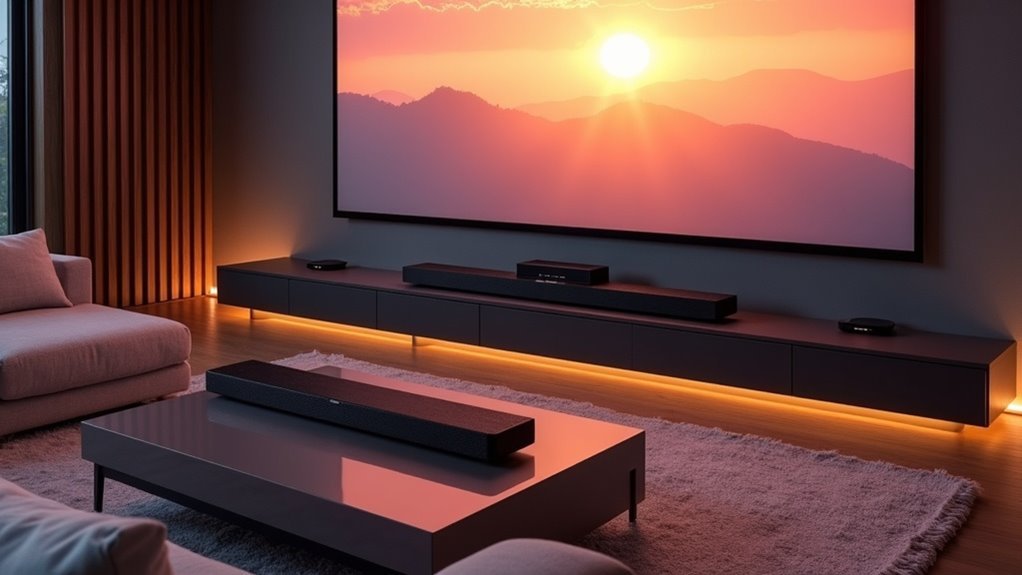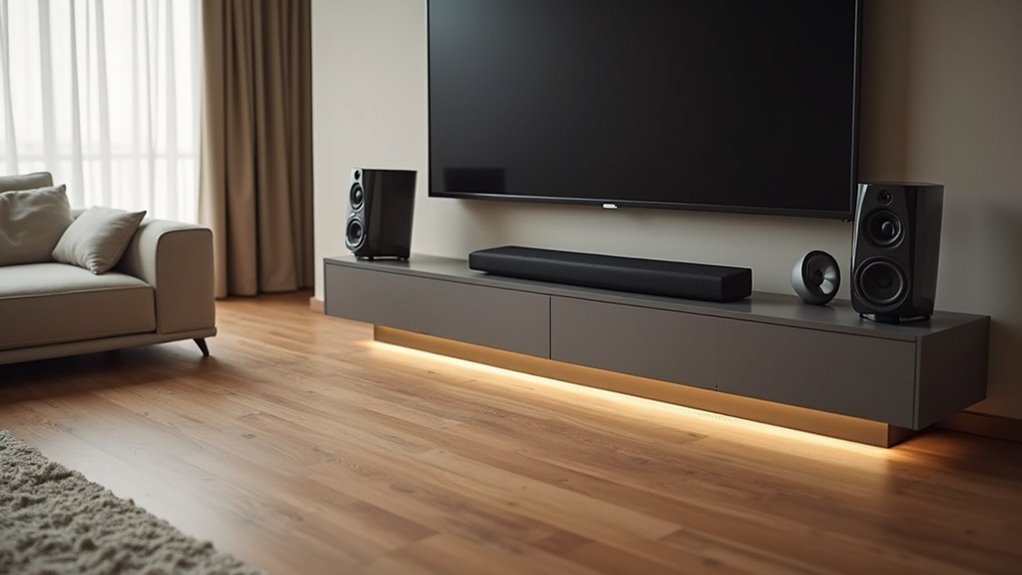
To position rear speakers effectively with your soundbar, ensure they are placed at ear level, ideally 2-3 feet behind your main listening area. Angling them toward the audience will enhance sound directionality. If space is limited, consider wall-mounting the speakers to save floor space while preserving height. For a 5.1 system, aim for a placement that forms a 110 to 120-degree angle to create an immersive sound experience. Making minor adjustments can further improve clarity. Keep these tips in mind to optimize your soundbar setup for the best audio performance.
Key Takeaways
- Position rear speakers 2-3 feet behind the main listening area when using a soundbar to achieve optimal sound depth and immersion.
- Ensure rear speakers are at ear level or slightly above for maximum clarity and engagement, complementing the soundbar’s output.
- Orient rear speakers towards the main listening area to enhance sound directionality and effectiveness alongside the soundbar.
- Maintain angles of 110 to 120 degrees between speakers in a 5.1 configuration for balanced audio that works well with the soundbar.
- Regularly experiment with speaker placement to adapt to room acoustics and furniture layout, ensuring the best audio experience when paired with your soundbar.
Importance of Rear Speaker Placement
When considering the overall audio experience with soundbars, the placement of any additional speakers, including rear speakers, is essential for achieving sound immersion. Properly positioned rear speakers can enhance the sound dynamics of a soundbar setup, capturing audio from behind you and creating a more lifelike environment.
Ideally, place surround sound speakers in the rear half of the room, at ear level or slightly above, angled towards you for maximum clarity. Aim for a setup with angles of 110 to 120 degrees in a 5.1 configuration to envelop yourself in sound, complementing the soundbar’s performance.
Listening to community feedback on soundbar and speaker placement can also help refine your setup, ensuring a more impactful audio experience tailored to your preferences.
Recommended Placement Heights
Proper placement heights for soundbars significantly impact sound clarity and immersion.
Ideally, position your soundbar at ear level, around 3 to 4 feet off the ground when seated. If you opt for wall mounting, aim for a height that aligns with your television to ensure optimal sound projection towards your listening area.
Position your soundbar at ear level, ideally 3 to 4 feet off the ground for the best audio experience.
For best results, place the soundbar directly below or above the screen, ensuring it’s centered for balanced audio. In smaller rooms, you might slightly elevate the soundbar, but ensure it remains within the optimal range to maintain audio quality.
Minor height adjustments can notably enhance your listening experience, so don’t hesitate to experiment.
Considerations for Small Spaces
Although small spaces can present challenges for soundbar placement, there are effective strategies to optimize sound quality without sacrificing room aesthetics. Consider these options:
- Wall Mounting: Save floor space while ensuring the soundbar is positioned at ear level for an immersive listening experience.
- TV Stand Placement: Position the soundbar directly beneath your television to enhance dialogue clarity and overall sound distribution.
- Corner Placement: If space is limited, place the soundbar in a corner to maximize sound projection, keeping it angled towards the main listening area.
- Wireless Options: Enjoy the flexibility of wireless soundbars to avoid clutter from traditional setups while maintaining high audio quality.
Regularly reassess the soundbar’s position to adapt to your changing room dynamics, ensuring the best sound balance in compact environments.
Positioning for Optimal Sound Direction
To achieve ideal sound direction with your soundbar, position it strategically in the front half of the room, ideally centered just below your TV.
Mount it at ear level for optimal sound projection, ensuring that the audio is directed towards the main listening area. If wall mounting, ensure the soundbar is angled slightly upward to create a more immersive audio experience.
Alternatively, placing it on a TV stand allows for direct sound engagement with the audience.
Experimenting with different placements and angles can yield significant improvements, as even slight adjustments can enhance clarity and immersion, guaranteeing your soundbar delivers the best possible audio experience.
Utilizing Wireless Rear Speakers
Utilizing wireless rear speakers in conjunction with a soundbar can greatly enhance your home audio experience by providing flexibility in placement and eliminating cable clutter.
To optimize your rear (surround) speaker placement when paired with a soundbar, consider the following:
Optimize your rear speaker placement by positioning them at ear level, behind the listening area, and oriented towards the soundbar.
- Position the rear speakers at ear level or slightly above for optimal sound immersion.
- Place them 2-3 feet behind the main listening area to create a sense of depth.
- Orient the speakers towards the main listening area for effective sound directionality, complementing the soundbar’s audio output.
- Experiment with placement to account for room acoustics and furniture layout, avoiding obstacles that may obstruct sound waves for a seamless audio experience.
Rear Speaker Placement for 5.1 Systems
When setting up a soundbar system, rear speaker placement isn’t applicable as soundbars are designed to simulate surround sound without the need for separate rear speakers.
Instead, focus on positioning the soundbar itself in front of the main listening area, ideally mounted at ear level or placed on a stand that aligns with your ears when seated.
Ensure that the soundbar is centered with respect to your TV for optimal audio performance.
If your soundbar supports additional wireless rear speakers, place them in the rear half of the room, angling them towards the listening position to enhance the immersive experience.
Experiment with placement to find the best balance based on your room’s unique layout and acoustics.
Rear Speaker Placement for 7.1 Systems
In a soundbar setup, proper placement is crucial for achieving an immersive audio experience.
To optimize your soundbar, follow these guidelines:
- Position the soundbar directly below or above your television for optimal alignment with the screen.
- Ensure the soundbar is at ear level when seated for the best sound projection.
- Keep the soundbar free from obstructions, such as furniture or decorations, that may block the sound.
- If using additional speakers or subwoofers, space them evenly to maintain a cohesive soundstage.
This setup enhances overall sound immersion effectively.
Experimenting With Speaker Angles
To achieve ideal soundbar orientation, you’ll need to experiment with angles that direct sound effectively toward your listening area.
Adjusting for room acoustics can enhance your audio experience, as different surfaces and layouts will influence how sound waves travel.
Optimal Speaker Orientation
Positioning your soundbar effectively is essential for achieving optimal sound immersion, and experimenting with its placement can greatly impact audio performance.
Here are key considerations for the best orientation:
- Place the soundbar at ear level or slightly above, directed towards the listening area.
- Ensure the soundbar is centered with respect to your viewing area to enhance sound stage cohesion for an immersive experience.
- If the soundbar has surround capabilities, consider adding rear speakers placed strategically in the room for a fuller sound.
- Regularly reassess the soundbar’s position based on room layout to optimize audio distribution and overall performance.
Adjusting for Room Acoustics
While the arrangement of soundbars greatly impacts sound quality, adjusting their placement can enhance the listening experience even further.
Experiment with positioning your soundbar at ear level or slightly above, ideally centered with your main viewing area for optimal sound directionality.
Ensure there’s enough clearance from any nearby walls to improve sound dispersion.
Testing different placements and distances from the wall can influence audio clarity, as reflections can enhance or muddle your experience.
Conducting trial and error with these adjustments can lead to noticeable improvements in your overall audio enjoyment.