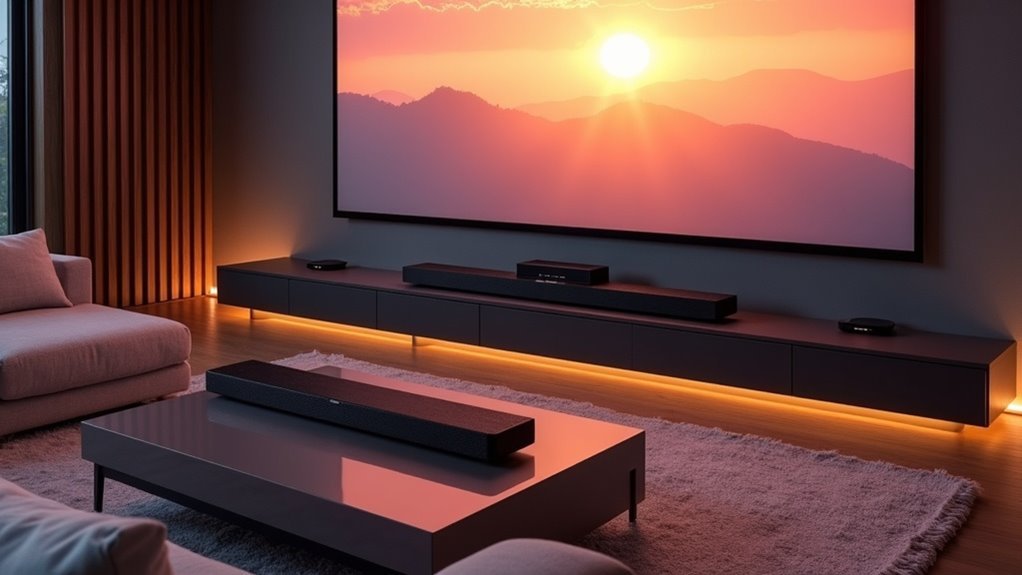
Soundbars can achieve impressive volume levels, typically ranging from 80 dB to over 100 dB. For example, the Samsung HW-Q990F reaches up to 100 dB, making it suitable for larger spaces. Higher wattage and dedicated subwoofers enhance loudness and bass response, while advanced technologies like Dolby Atmos maintain clarity at elevated outputs. Understanding how these factors interact can optimize your soundbar experience, so there’s much more to explore in maximizing sound quality and performance with soundbars.
Key Takeaways
- Most soundbars can produce sound levels ranging from 80 dB to over 110 dB at maximum output, depending on the specific model and its features.
- High-end soundbars, like the Samsung HW-Q990F, are capable of reaching up to 100 dB, providing an immersive audio experience.
- The loudness of a soundbar is influenced by factors such as wattage, the number of drivers, and the inclusion of dedicated subwoofers, which enhance bass performance.
- Room acoustics significantly impact perceived loudness; for instance, hard surfaces can amplify sound levels.
- For the best listening experience, small rooms should target sound levels of 60-70 dB, whereas larger spaces often require 85 dB or more for optimal audio enjoyment.
Understanding Sound Pressure Levels
When you’re considering how loud a soundbar can get, it’s essential to understand Sound Pressure Levels (SPL), which are measured in decibels (dB).
Typical home soundbars range from 80 dB to 110 dB at maximum output. Significantly, 85 dB is the threshold for potential hearing damage, underscoring the importance of volume control.
High-end soundbars often feature multiple drivers and subwoofers, achieving higher SPLs while preserving sound clarity.
High-end soundbars utilize multiple drivers and subwoofers to deliver impressive sound levels without sacrificing clarity.
Additionally, technologies like Dolby Atmos enhance your listening experience, making soundbars feel louder and more dynamic, even at lower dB levels—an important consideration for immersive audio enjoyment in your home entertainment setup.
Factors Affecting Volume Output
Several factors influence the volume output of soundbars, significantly affecting your overall listening experience. One of the primary determinants is wattage, which dictates how loud a soundbar can be; higher wattage levels allow for greater volume without distortion.
Soundbars that come with dedicated subwoofers are particularly effective at enhancing loudness and bass response, providing a richer audio experience. The number of channels—such as 2.1 or 5.1—also plays a crucial role in sound dispersion, with multi-channel setups typically perceived as louder.
Furthermore, the acoustic properties of the room can greatly impact performance; hard surfaces amplify sound, while soft furnishings tend to absorb it. Additionally, modern technologies like Dolby Atmos optimize output, ensuring clarity even at higher volumes without compromising sound quality.
Comparing Soundbar Models
When comparing soundbar models, it’s important to focus on sound output measurements, bass performance, and overall volume capabilities.
Pay close attention to specifications such as wattage and decibel levels, as they significantly affect your listening experience.
Understanding these factors will guide you in selecting a soundbar that meets your requirements for both clarity and loudness.
Sound Output Measurements
While sound output measurements can vary considerably across different soundbar models, understanding these variations is essential for selecting the right audio solution for your needs.
Most soundbars deliver sound output ranging from 80 dB to over 100 dB, catering to large spaces. High-end models, like the Samsung HW-Q990F, can achieve up to 100 dB, ensuring an immersive experience.
The JBL RALLYBAR often exceeds 95 dB, providing clarity and volume. Soundbars equipped with subwoofers, such as the Nakamichi Shockwafe Ultra 9.2 SSE, enhance overall performance.
Advanced audio technologies allow these systems to maintain clarity without distortion at high output levels, making them a popular choice for home theater enthusiasts.
Bass Performance Comparison
How do different soundbar models stack up regarding bass performance? Comparing options can help you find the right fit for immersive audio experiences.
| Soundbar Model | Subwoofer Type | Bass Performance |
|---|---|---|
| JBL RALLYBAR | Built-in | Loud, balanced |
| Nakamichi Shockwafe Ultra 9.2 SSE | Dedicated subwoofer | Deep, powerful |
| Samsung HW-Q990F | Built-in + Dolby Atmos | Enhanced, immersive |
| Sonos Arc | Customizable subwoofer | Tunable, flexible |
These soundbars cater to various preferences, ensuring you enjoy the bass performance that suits your music and movie needs. Whether you prefer a built-in option or a dedicated subwoofer, there’s a soundbar for everyone looking to enhance their audio experience.
Volume Capabilities Explained
Many soundbars deliver impressive volume capabilities, making them suitable for various audio environments. Typically, soundbars range from 80 to 100 decibels in volume output, with models like the Nakamichi Shockwafe Ultra 9.2 SSE exceeding 100 dB for immersive experiences.
Brands such as JBL RALLYBAR and Powerbass XL1200 excel in loudness, ideal for larger spaces. Built-in amplification guarantees high volume levels without distortion, enhancing music and movie playback.
Incorporating external subwoofers greatly boosts overall loudness and bass response. Remember, soundbar placement and room acoustics are crucial; a soundbar can seem louder in a small, well-treated room than in a large, echo-prone space.
This knowledge is essential for selecting the right soundbar for your audio needs.
The Role of Subwoofers in Volume
Subwoofers play an essential role in enhancing the volume and depth of sound in soundbar systems, ensuring that you experience a richer audio landscape.
By effectively reproducing low-frequency sounds, subwoofers greatly increase the overall volume, providing a more immersive audio experience, especially for action movies and bass-heavy music.
Soundbars equipped with dedicated subwoofers can achieve higher sound pressure levels, often exceeding 100 dB, making them suitable for larger spaces.
Additionally, wireless subwoofers enhance flexibility in placement, optimizing sound distribution while delivering louder, clearer audio without compromising quality.
This combination elevates your soundbar experience to a whole new level, bringing your home entertainment to life.
Ideal Volume Levels for Different Spaces
When choosing the ideal volume level for your soundbar, consider the size of the room and your listening distance.
In smaller spaces, aim for 60 to 70 dB to create an intimate audio experience.
Medium rooms benefit from 70 to 85 dB to enhance clarity and immersion, making your soundbar perform at its best.
For larger areas, ensure your soundbar can deliver 85 dB or more to effectively fill the space with rich sound without sacrificing audio quality.
Room Size Considerations
Understanding how room size impacts soundbar performance is essential for achieving an ideal audio experience with your soundbar.
In small rooms (100-200 square feet), soundbars can reach volume levels of 70-80 decibels without distortion, making them perfect for casual listening.
In medium-sized spaces (300-400 square feet), you can expect volume levels of 80-90 decibels, which enhances your home theater experience.
However, larger rooms (over 500 square feet) often require external subwoofers or surround speakers to effectively exceed 90 decibels.
Additionally, acoustic factors like room layout and ceiling height considerably influence sound clarity.
For optimal results with your soundbar, aim for volume levels between 75-85 decibels to balance dialogue clarity and impactful sound effects.
Listening Distance Importance
How far you sit from your soundbar substantially affects the ideal volume levels for an immersive audio experience.
Understanding your listening distance helps you optimize sound quality from your soundbar. Here are key considerations:
- Typical volume levels for soundbars should range from 70 to 85 dB in standard rooms.
- Larger spaces may require soundbar volume levels of 85 dB or higher.
- For distances of 10 to 14 feet, boost the soundbar volume for clarity.
- Dedicated subwoofers paired with your soundbar enhance bass response at greater distances.
- Room acoustics, like vaulted ceilings, can necessitate adjustments to your soundbar’s volume for optimal performance.
Distortion and Sound Quality Considerations
While soundbars can deliver impressive volume levels, often surpassing 100 decibels, it’s essential to consider how this affects sound quality. Pushing soundbars to their limits may introduce distortion, particularly in lower frequencies, resulting in muddled audio that can detract from the overall experience. To counteract this, integrating dedicated subwoofers can effectively manage bass, allowing soundbars to concentrate on delivering clearer mid and high frequencies. Furthermore, high-end soundbar models equipped with Dolby Atmos technology are engineered to maintain sound quality even at elevated outputs, significantly reducing distortion in complex soundscapes.
| Feature | Impact on Sound Quality |
|---|---|
| High Wattage | Produces louder sound |
| Dedicated Subwoofers | Reduces distortion |
| Dolby Atmos | Maintains clarity at volume |
| Speaker Configuration | Enhances overall output |
Recommendations for Optimal Listening Experience
To achieve the ideal listening experience with your soundbar, it’s important to consider both volume levels and room acoustics. Aim for moderate volume levels around 70-85 decibels for the best clarity and dynamic sound.
Achieving optimal sound quality requires balancing volume levels and room acoustics, ideally around 70-85 decibels for clarity.
Follow these recommendations:
- Position your soundbar at ear level for enhanced audio quality.
- Use a dedicated subwoofer to enrich bass performance and elevate your listening experience.
- Pair your soundbar with rear speakers in larger rooms to ensure even sound distribution throughout the space.
- Experiment with room placement to minimize distortion and maximize sound quality.
- Leverage advanced sound technologies in models like the Samsung HW-Q990F and Sonos Arc for crisp audio even at higher volumes.
Future Trends in Soundbar Technology
As soundbar technology continues to evolve, you can expect significant advancements that enhance audio immersion and user experience.
Upcoming soundbars will increasingly support Dolby Atmos and DTS:X for an immersive 3D sound experience. AI-driven sound calibration will optimize audio settings based on your room acoustics and content, ensuring peak performance.
Enhanced wireless connectivity options, including Wi-Fi and Bluetooth 5.0, will facilitate seamless streaming and multi-room setups. Manufacturers will also prioritize sustainability, utilizing eco-friendly materials and energy-efficient designs.
The trend towards all-in-one solutions will continue, with more soundbars featuring built-in subwoofers and surround speakers, offering compact yet powerful home theater experiences.
Explore the future of soundbars and stay updated on the latest innovations in audio technology.