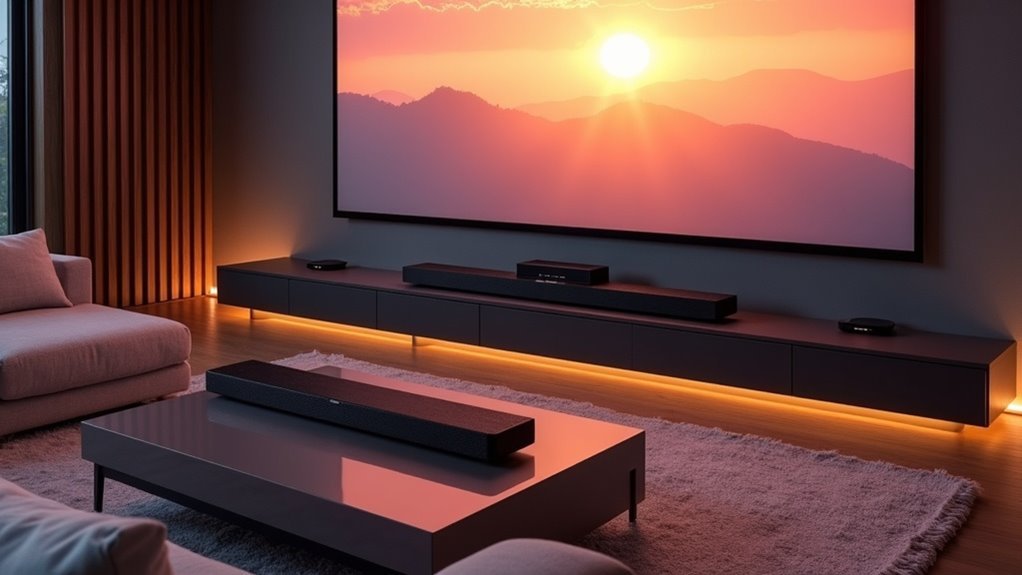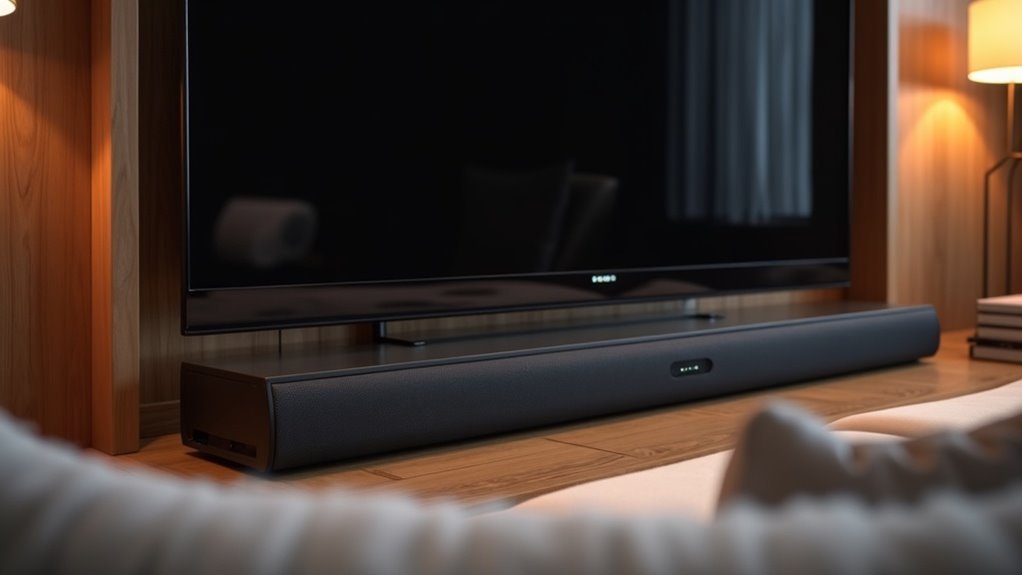
Soundbars come in various channel configurations, ranging from 2.0 to advanced 11.1.4 setups. The first number indicates the total speakers, while the second denotes subwoofers for deeper bass. Up-firing channels are often included for height effects, especially with formats like Dolby Atmos. Choosing the right configuration can enhance your audio experience considerably. By understanding these options, you can find a soundbar that perfectly matches your needs and preferences. For further details on selection criteria, please explore our comprehensive guides on soundbars.
Key Takeaways
Soundbars typically range from 2.0 channels to advanced 11.1.4 configurations, allowing for various audio experiences. The first number in a soundbar’s configuration represents total speakers, while the second indicates subwoofers for deep bass. Common configurations include 2.1 for casual listening, 5.1 for surround sound, and 7.1.4 for immersive height effects. Up-firing channels enhance audio experiences for formats like Dolby Atmos, adding depth to sound. Popular brands offer diverse channel options, catering to different room sizes and audio preferences.
Understanding Soundbar Channels
What do soundbar channels really mean for your audio experience? The number of channels in a soundbar indicates how many speakers it has, which directly affects sound quality and realism.
A typical soundbar setup might be 2.1, featuring two horizontal channels along with a subwoofer. If you’re looking for a more immersive experience, a 5.1.2 configuration includes two up-firing channels that create virtual surround effects, making it essential for formats like Dolby Atmos and DTS:X.
For those seeking even higher fidelity, configurations like 7.1 or 9.1.4 provide superior surround sound, enhancing your home theater experience. Understanding these various configurations will help you select a soundbar that perfectly aligns with your audio preferences.
The Importance of Channel Configuration
Channel configuration is vital for achieving an immersive audio experience with soundbars.
The number of channels determines how sound is distributed in your space, affecting the overall quality and realism of the audio.
For a truly cinematic feel, opting for a soundbar with multiple channels and a subwoofer is essential.
Channel Count Significance
Understanding the significance of channel count in soundbars is essential for enhancing your audio experience. The channel count directly affects sound quality, as it indicates the number of audio channels and their configurations.
Higher counts like 5.1 or 11.1.4 provide true surround sound by improving directionality and spatial effects. The first number represents horizontal channels, while the second denotes subwoofer connection for deep bass.
Additionally, up-firing channels create height in sound, enriching formats like Dolby Atmos. Soundbars use this configuration to deliver immersive audio experiences, making channel count a critical factor in your choice of soundbar.
Immersive Audio Experience
When you’re looking to elevate your soundbar audio experience, the configuration of channels plays a pivotal role. Higher channel counts enhance sound directionality and realism, providing an immersive quality that transforms your listening environment.
Consider these elements:
- Surround sound for enveloping audio
- Up-firing channels for height effects
- Subwoofers for deep bass
- Spatial audio for richer sound projection
A minimum of 5.1 channels is recommended for a cinematic atmosphere, supporting advanced audio formats like Dolby Atmos.
Ultimately, selecting the right soundbar configuration guarantees a superior audio experience tailored to your needs.
Different Channel Types Explained
A soundbar’s channel configuration plays an essential role in delivering an immersive audio experience. The number of channels indicates how many speakers are included, with configurations ranging from basic 2.0 systems to advanced 11.1.4 setups.
The first number shows total speakers, while the second denotes subwoofers, which are vital for deep bass. Up-firing channels, indicated by a third number, enhance height effects, enriching your audio quality, especially for Dolby Atmos content.
The first number indicates total speakers, while the second represents subwoofers essential for deep bass and immersive sound.
Common configurations like 5.1 or 7.1 provide robust sound, while higher counts cater to audiophiles seeking realistic environments.
Connecting your soundbar via HDMI cable optimizes this immersive sound experience, ensuring you get the most out of your audio setup.
How Many Channels Do You Need?
Choosing the right number of channels for your soundbar depends on your specific audio needs and the environment where you’ll use it.
- A basic 2.0 channel soundbar offers good sound quality for casual TV watching.
- A 3.1 channel soundbar enhances bass frequencies with a wireless subwoofer, making it perfect for movie nights.
- For a more immersive experience, consider a 5.1 channel soundbar that provides surround sound for gaming and films.
- If you’re a home theatre enthusiast, advanced 5.1.2 or 7.1.4 setups deliver height effects for an enriched Dolby Atmos experience.
Ultimately, your choice should align with your room size and desired audio output, ensuring you get the best soundbar experience tailored to your needs.
Selecting the Right Soundbar for Your Setup
Selecting the right soundbar for your setup is essential for enhancing your audio experience. It’s important to consider your audio preferences and the specific characteristics of your room. Soundbars come with various channel configurations, each impacting your listening experience. Here’s a quick comparison:
| Channel Setup | Ideal For | Features |
|---|---|---|
| 1 Channel | Basic TV audio | Minimalist design, space-saving |
| 2.1 Channels | Casual viewers | Enhanced bass, Bluetooth connectivity |
| 5.1 Channels | Home theater enthusiasts | Immersive audio experience, surround sound |
Evaluating the channel configuration is key to improving audio quality in your space. Generally, higher channel counts provide richer sound, so make your choice wisely to suit your needs.
Popular Soundbar Brands and Their Offerings
When selecting a soundbar, it’s essential to consider the top brands and their channel configurations.
Samsung, Sonos, Bose, Vizio, and Klipsch provide a range of models designed to meet diverse audio requirements, from immersive Dolby Atmos systems to more affordable choices.
Familiarizing yourself with these offerings will assist you in choosing the ideal soundbar for your home entertainment setup.
Leading Soundbar Brands
Several leading soundbar brands dominate the market, each offering unique configurations to suit various audio needs and preferences.
When buying a soundbar, consider these options:
- Sonos: Offers models ranging from 2.0 to 11.1.4 channels, making it suitable for any room size.
- Samsung: The Q-series features models with 3.1 to 9.1.4 channels, all supporting Dolby Atmos for an immersive experience.
- Bose: Known for models with 3.0 to 5.1 channels, Bose emphasizes clear dialogue and deep bass for an enhanced listening experience.
- Vizio: Provides competitive pricing with options from 2.1 to 5.1.2 channels, often including wireless subwoofers for added convenience.
These brands empower you to find soundbars that significantly enhance your TV’s audio quality, delivering rich sound experiences even for smaller televisions.
Channel Configurations Available
Soundbars come in a variety of channel configurations, allowing you to choose the setup that best fits your audio preferences and room size.
For instance, Yamaha’s YAS-209 features a simple 2.1 system with one subwoofer for deep bass.
If you’re looking for something more advanced, consider Sonos Arc with five main channels and two height channels for immersive Dolby Atmos sound.
Samsung’s Q950A pushes boundaries with an 11.1.4 configuration, while Vizio’s Elevate offers a unique 5.1.4 setup.
Each soundbar utilizes optical audio to enhance your experience, ensuring you find the best one for your needs.