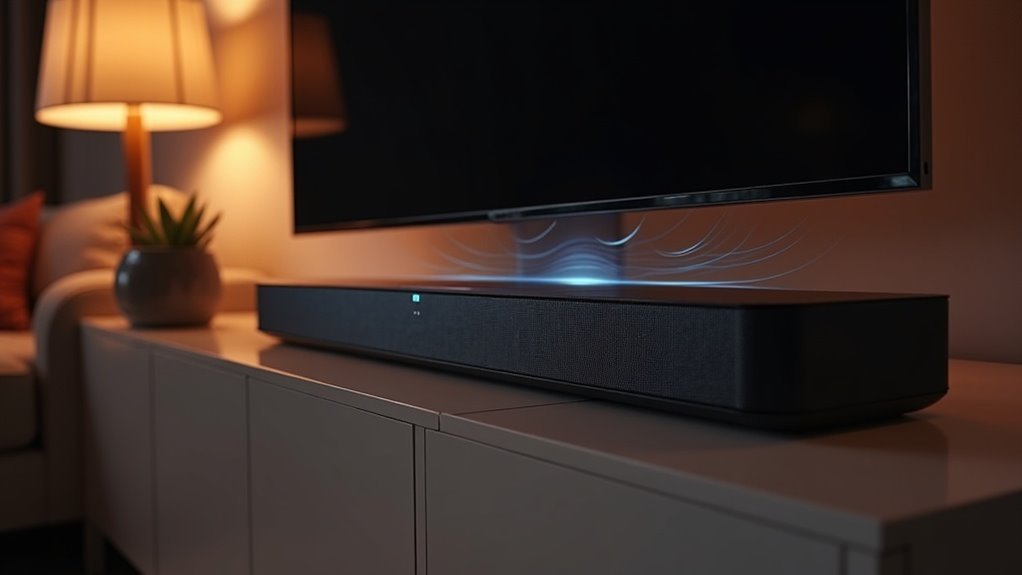
Soundbars enhance your TV’s audio by utilizing multiple speaker drivers, including tweeters and woofers. They process audio through built-in digital signal processors (DSP), which manage sound customization and decode signals for optimal performance. You can connect soundbars via HDMI ARC, optical cables, or Bluetooth for a seamless audio experience. Internal amplifiers boost sound clarity, while advanced audio technologies like Dolby Atmos deliver an immersive listening experience. Discovering the right features in a soundbar can significantly elevate your audio journey.
Key Takeaways
- Soundbars utilize multiple speaker drivers to deliver a broad spectrum of audio frequencies, significantly improving sound quality compared to standard TV speakers.
- They can be connected to TVs through HDMI ARC, optical cables, or Bluetooth, providing flexible and user-friendly installation options.
- Internal digital signal processors (DSP) are employed to customize audio settings, optimizing signal decoding for superior sound performance.
- Amplifiers enhance the processed audio signals, guaranteeing clear and powerful sound output suitable for various types of content.
- Many soundbars are compatible with advanced audio technologies like Dolby Atmos, creating an immersive listening experience.
Understanding the Sound Bar
A sound bar is a compact audio system designed to significantly improve your television’s sound quality. Typically, it contains multiple speaker drivers, such as tweeters, mid-range drivers, and woofers, which deliver superior audio clarity compared to your TV’s built-in speakers.
Many advanced models support immersive audio technologies like Dolby Atmos, providing a surround sound experience with upward-firing speakers. Connecting a sound bar to your TV is straightforward, usually done via HDMI ARC or optical cables, allowing for a hassle-free setup without complicated wiring.
Additionally, many sound bars come equipped with built-in digital signal processors (DSP) that enhance audio and simulate surround sound effects, creating a more engaging listening experience.
Components of a Sound Bar
Sound bars feature a variety of essential components that work together to deliver an enhanced audio experience. They typically include multiple speakers: tweeters for high frequencies, mid-range drivers for vocal clarity, and woofers for deep bass, all within a single enclosure.
Internal amplifiers power these speaker drivers, improving sound output. A Digital Signal Processor (DSP) manages audio customization, enabling features like virtual surround sound effects.
Additionally, connectivity options such as HDMI ARC, optical inputs, Bluetooth, and Wi-Fi guarantee seamless integration with your TV and other devices. The enclosure design considerably influences sound quality and overall acoustic performance.
How Soundbars Process Audio
When you connect a soundbar, it processes the audio signal input through various methods, such as HDMI ARC or Bluetooth.
The Digital Signal Processor (DSP) decodes these signals and applies enhancements to optimize sound quality.
This combination of input and processing techniques ensures that you experience clear and powerful audio output, enhancing your overall soundbar experience.
Audio Signal Input
Multiple input options allow soundbars to seamlessly integrate with various devices, enhancing your audio experience. They accept audio signal input through HDMI ARC, optical cables, and Bluetooth connectivity, providing versatility for your home entertainment setup.
Once the signal is received, the built-in Digital Signal Processor (DSP) decodes the format and applies sound customization enhancements. This guarantees features like virtual surround sound create a more immersive experience.
Amplifiers boost the processed audio signals, delivering powerful and clear output. Finally, speaker drivers, including tweeters and woofers, emit the enhanced audio, accurately reproducing frequencies across a wide range for peak sound quality, making your listening experience truly enjoyable.
Soundbars elevate your audio experience, ensuring every movie, song, and game sounds its best.
Signal Processing Techniques
To fully appreciate the audio experience a soundbar provides, it’s essential to understand the signal processing techniques that elevate sound quality.
Soundbars utilize advanced Digital Signal Processors (DSP) to enhance audio output by:
- Analyzing and optimizing inputs from HDMI, optical, or Bluetooth sources.
- Creating immersive experiences with algorithms that simulate three-dimensional sound placement.
- Supporting formats like Dolby Atmos for superior cinematic sound effects.
These signal processing techniques guarantee clear dialogue and dynamic sound, transforming your listening experience from standard TV speakers to an enthralling auditory journey that immerses you in every detail of your favorite content.
Embrace the power of soundbars and unlock a new level of audio excellence in your home entertainment setup.
Audio Signal Input and Signal Processing
When you connect your soundbar, it can receive audio signals through HDMI ARC, optical cables, or Bluetooth, ensuring versatile compatibility with your devices.
Once the signal enters, the Digital Signal Processor (DSP) takes charge, decoding the audio formats and enhancing sound quality specifically for soundbars.
After processing, internal amplifiers boost the signals to drive the speaker drivers, delivering clear and immersive audio tailored for an enhanced listening experience.
Audio Input Methods
How do soundbars connect to your devices and process audio signals?
Soundbars utilize various audio input methods to achieve versatile connectivity, enhancing your listening experience.
Key connections include:
- HDMI ARC: This simplifies your setup by using a single cable to transmit both audio and video.
- Optical Audio Cables: These provide high-quality audio transfer without interference.
- Bluetooth: This wireless option allows you to stream audio from multiple devices easily.
Once the audio signals are received, a digital signal processor decodes them, optimizing clarity and creating an immersive listening experience tailored to your content.
Processing and Amplification
After the soundbar receives audio signals through various input methods, the next step involves processing and amplification, which are essential for delivering high-quality sound.
The Digital Signal Processor (DSP) decodes audio formats and enhances sound quality based on the content. Internal amplifiers then boost these processed signals, driving the speaker drivers—tweeters, mid-range drivers, and woofers—for improved volume and clarity.
Additionally, soundbars often incorporate virtual surround sound technology, simulating a multi-speaker setup to elevate your audio experience.
Amplification and Sound Emission
While many audio systems rely on separate components for amplification and sound emission, soundbars streamline this process by integrating internal amplifiers that significantly enhance audio output. This amplification converts low-level audio signals into higher-voltage signals, efficiently delivering them to the speaker drivers found within the soundbar.
- Speaker drivers in a soundbar typically include tweeters, mid-range drivers, and woofers, enabling the soundbar to produce a full range of frequencies.
- Digital signal processors (DSPs) within soundbars enhance sound quality by customizing audio for clarity and spatial effects, ensuring an immersive listening experience.
- The strategic arrangement of speaker drivers within the soundbar’s enclosure optimizes frequency response, further elevating audio enjoyment.
Together, these integrated elements make soundbars a convenient and effective solution for enhancing your audio experience at home.
Benefits of Enhanced TV Audio
Enhanced audio from soundbars transforms your viewing experience by delivering superior clarity and depth.
With a soundbar, you’ll enjoy clearer dialogue and more pronounced sound effects, reducing the need for subtitles and constant volume adjustments. Research shows that soundbars outperform built-in TV speakers, offering enriched spectral clarity that enhances your home theater setup.
Many soundbar models support advanced audio technologies like Dolby Atmos, creating an immersive listening experience that simulates multidimensional sound.
This upgrade not only elevates movie and gaming sessions but also enriches music listening, providing a dynamic sound quality unmatched by typical stereo systems or standard audio cables.
Choosing the Right Soundbar for Your Needs
How do you choose the right soundbar for your needs? Start by considering your room size, as the audio experience varies with space and placement.
Here are key factors to keep in mind when selecting the perfect soundbar:
- Separate Subwoofer: For bass-heavy content, opt for soundbars that come with a separate subwoofer to enhance low-frequency sounds and improve overall audio quality.
- HDMI eARC Compatibility: Ensure the soundbar has HDMI eARC compatibility to facilitate seamless connectivity with your devices and deliver superior audio performance.
- Multiple Channels: Look for soundbars with multiple channels to create a home theatre-like experience and achieve immersive surround sound that enhances your viewing experience.